
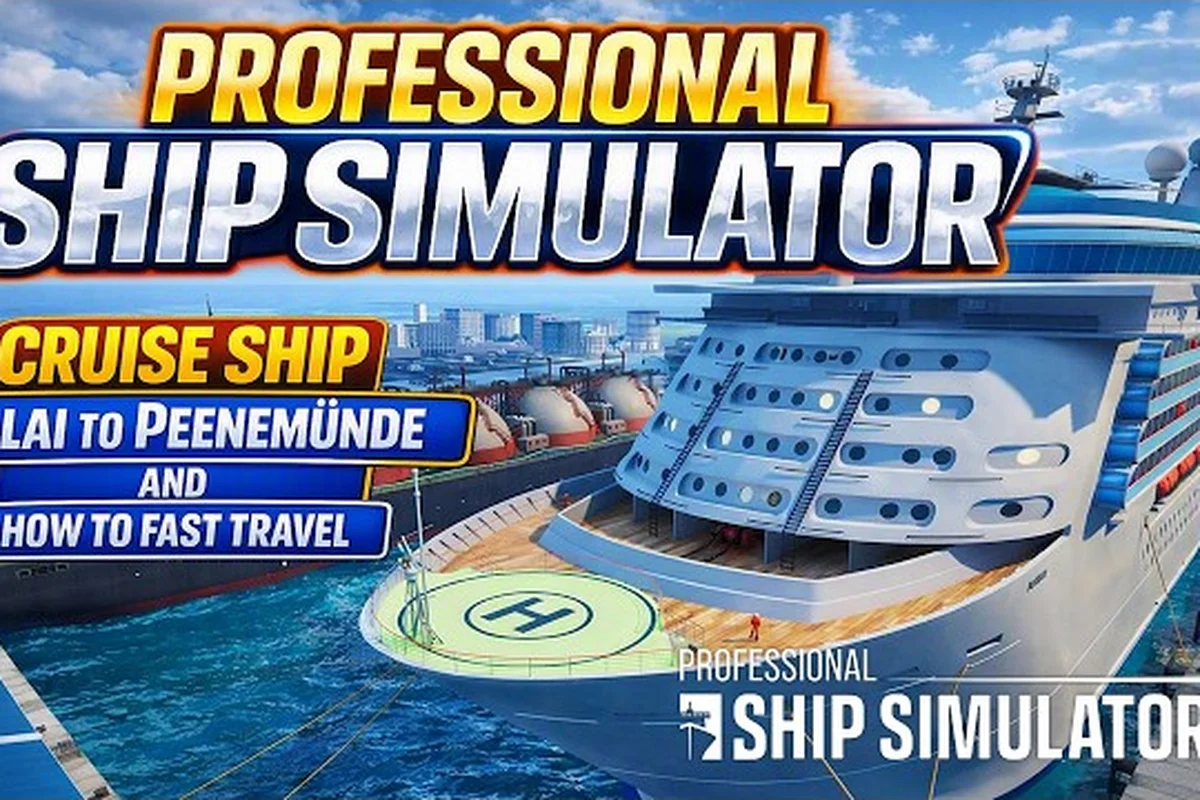
What Makes the Cruise Ship the Crown Jewel of the Dry-Dock Lineup
The cruise ship in Professional Ship Simulator is the flagship passenger vessel in the Early Access build, marketed as a medium-to-large class that picks up guests and shows them the world of the simulator. That single line from the official ship-class catalog tells you almost everything about the role it plays on the harbor roster: bigger than ferries, slower than a working trawler, and built around a guest-experience loop rather than a cargo contract. For players who have already burned through the pilot boat and small tug tier, the cruise ship is the natural graduation target — the vessel you save up for, license into, and use as the long-form payoff for a career playthrough.
What makes the cruise ship worth a dedicated guide is the combination of three things: a non-trivial license gate, the highest passenger capacity in the playable fleet, and a bridge layout that finally pulls together every system you learned piecemeal on smaller hulls. If you are weighing whether to skip straight to a freighter or tanker, the answer depends on whether your credits and captain XP are aligned with the cruise ship's specific unlocks. This guide walks through the full path — from license check to dry-dock purchase to first charter — and compares the cruise ship against every other ship class in the current build so you can decide whether it really is the vessel you should be chasing.
For broader context on how the cruise ship fits into the wider ship roster, the ship types explained breakdown catalogs every class currently sailing in Early Access, including the Medium Trawler and Container Feeder that are still pending their sea trials and therefore not yet purchasable.
How to Unlock the Cruise Ship: License Gates and Career Progression
Unlocking the cruise ship in Professional Ship Simulator follows the same career path as every other top-tier vessel, but the gates are tighter. According to the official Career knowledge base, each license check you pass expands the dry-dock catalog, and the cruise ship sits at the upper end of that progression tree. You do not buy your way into it with raw credits alone; you have to demonstrate bridge competency first, then prove your bankroll can absorb the hull price.
The License Path
The license system in Professional Ship Simulator is a series of practical exams that gate vessel access. The cruise ship class requires a high-tier captain license, which is only available once you have cleared the lower license checks for small craft, mid-size cargo, and at least one maneuvering-heavy class such as the pilot boat or harbor tug. Community testing suggests the cruise ship license check itself focuses on three competencies:
-
Slow-speed maneuvering within a constrained harbor basin
-
Passenger-aware docking (lining up the gangway ramp with the berth cleat)
-
Emergency stop and station-keeping under simulated weather penalty
These are not the same tests you passed to unlock a ferry, and they cannot be brute-forced by grinding cargo runs. If you want a fuller picture of the rank-by-rank progression, the captain rank guide maps every license tier to the vessel class it opens up.
The Credit Gate
Even after you pass the license, the dry-dock still has to approve the purchase. The cruise ship sits at the top of the Early Access ship prices curve, which means you cannot simply grind your way into it on small-hull payouts. According to community data collected from the Early Access release candidate, the rough price tier for the cruise ship is several multiples of what you would pay for a mid-tier cargo or ferry hull. Exact numbers shift between patches, so treat any figure you see in chat or on Reddit as last-verified for the build it was quoted on.
| License Tier | Vessel Class Unlocked | Estimated Dry-Dock Price Band | First-Mission Payout Range |
|---|---|---|---|
| Tier 1 | Pilot boat, Harbor tug | Low (starter band) | 200 – 600 credits |
| Tier 2 | Small ferry, Motor vessel | Low-to-mid | 500 – 1,200 credits |
| Tier 3 | Mid-size ferry, Small cargo | Mid | 1,200 – 2,500 credits |
| Tier 4 | Container feeder (when released), LNG carrier (when released) | High | 2,500 – 5,000 credits |
| Tier 5 (capstone) | Cruise ship | Top of current build | 3,000 – 6,000+ credits per charter |
The table is built from community-reported data, not from an official price sheet — Professional Ship Simulator does not publish a static price list because ship prices scale with mission modifiers, harbor choice, and patch version. As of the Early Access release candidate, players report a soft target of around 80,000 to 120,000 credits in the bank before the cruise ship becomes a comfortable purchase rather than a credit-draining gamble.
Proving You Can Actually Drive It
The license check is the formal gate, but there is an informal one: handling a cruise ship without embarrassing yourself in open harbor. A cruise ship handles very differently from a ferry or cargo hull, and if you have only driven small craft, the first session on the cruise bridge can feel disorienting. The simulator does not gate you from buying a ship you cannot yet sail well, but a botched charter will cut into your payout and may even trigger a mission fail if you damage the gangway or the berth. The first-docking workflow covered in the docking guide applies to cruise ships as well, but the scale of the hull multiplies every error.
How to Buy the Cruise Ship at the Dry-Dock
Once you have the license and the credits, the actual how to buy ships workflow in Professional Ship Simulator is the same regardless of class. You sail to a dry-dock harbor, dock at the service pier, and interact with the dockyard NPC. The dry-dock menu then shows every vessel your license tier permits, with the cruise ship appearing only if both the license and the funds are in place. There is no auction, no RNG, and no hidden questline — the cruise ship is a straight credit transaction.
The catch is that dry-dock availability is harbor-specific. Not every harbor in the current build stocks the cruise ship; smaller harbors around the Rügen island cluster tend to only carry the small-hull lineup, and you may need to fast-travel to a larger hub to find the cruise ship on the purchase menu. The harbor-residence system (buying a residence to unlock a new fast-travel destination) interacts with this: if your residence is at a small harbor, you are paying fast-travel fees to reach a dry-dock that actually stocks the vessel you want.
What the Dry-Dock Menu Actually Shows
When you open the dry-dock interface on a harbor that stocks the cruise ship, you see a class selector, a list of currently purchasable hulls, and a stat block for the selected vessel. For the cruise ship, the stat block is where you confirm the specific ship handling profile you are committing to. Key numbers to verify before you click purchase:
-
Length overall (LOA) — confirms the hull size for harbor-entry planning
-
Passenger capacity — the headline figure, typically the highest in the fleet
-
Maximum speed — slower than a ferry, but with a higher cruise comfort band
-
Maneuvering rating — affects rudder response and thruster strength
-
Fuel capacity — relevant for multi-day charter itineraries
-
Bridge system count — the cruise ship bridge has more clickable systems than any small-hull vessel
Players report that the cruise ship is one of the most expensive single purchases in the Early Access build, but unlike a freighter or LNG carrier (which the community expects to be gated behind later license tiers), the cruise ship is purchasable right now as long as you have met the license gate.
Common Buy Mistakes
The two most common how to buy ships errors around the cruise ship in Professional Ship Simulator both revolve around ignoring the vessel's premium service profile: captains routinely lock in a purchase without first checking the destination harbor's service tier, and they underestimate the fuel burn rate that separates a cruise ship from lighter ferries or cargo haulers. The cruise hull sits at the top tier of the ship price ladder, so a single botched dry-dock event can wipe out several charters of profit before the new ownership even breaks even.
-
Buying at the wrong harbor — the dry-dock does not warn you that this specific pier will not service your new hull. Confirm harbor service tier before clicking purchase.
-
Underestimating the operating cost — the cruise ship burns more fuel per nautical mile than a ferry, and charter payouts are generous but not unlimited. Carry a credit reserve for fuel and any unexpected repair bills from a botched docking.
Cruise Ship vs Other Classes: A Side-by-Side Comparison
To answer which ship to buy at the upper tiers, you have to compare the cruise ship against every other class in the current Early Access roster. The official available ship classes page lists the full lineup as of the release candidate, and a few of the headline entries are worth flagging:
-
Medium Trawler — not yet available in Early Access, still completing sea trials
-
Container Feeder — same status as the Medium Trawler
-
LNG Carrier and Bulk Carrier — referenced in community roadmap notes but not yet purchasable
That means the cruise ship, in the current build, is competing primarily against the Ferry, Motor Vessel, Pilot Boat, and Harbor Tug for your top-tier credit and attention. Once the sea-trials-gated classes enter the catalog, the comparison table will need to be re-evaluated.
Ship Comparison Table: Cruise Ship Against the Rest of the Fleet
| Class | Size Band | Primary Role | Passenger Capacity | Top Speed Band | Payout Profile | Purchase Difficulty |
|---|---|---|---|---|---|---|
| Pilot boat | Small | Harbor assistance | Low | High | Per-assignment | Tier 1 license, low credits |
| Harbor tug | Small | Towing / berthing | None | Medium | Per-assignment | Tier 1 license, low credits |
| Motor vessel | Small-to-medium | Mixed small contracts | Low | Medium | Per-mission | Tier 2 license |
| Ferry | Small / Medium / Large | Passenger transit | Medium-to-high | Medium | Per-crossing | Tier 2–3 license |
| Cruise ship | Medium-to-large | Multi-day passenger charter | Highest in fleet | Medium-low | Per-charter (high) | Tier 5 license, top-tier credits |
| LNG carrier (pending) | Large | Specialized cargo | None | Low | Per-cargo (very high) | Future license gate |
| Bulk carrier (pending) | Large | Specialized cargo | None | Low | Per-cargo (high) | Future license gate |
| Container feeder (pending) | Medium | Container transit | None | Medium | Per-cargo (medium-high) | Future license gate |
The cruise ship wins on passenger capacity and per-charter payout, loses on top speed and dry-dock accessibility, and ties with the ferry on overall mission variety. If your career goal is credits-per-hour rather than prestige, a ferry is the more efficient grind target; if your goal is the headline vessel and the most bridge systems to learn, the cruise ship is the right call.
Speed, Fuel, and Range Trade-Offs
The cruise ship is not a slow vessel in absolute terms, but it is the slowest of the passenger classes. Where a ferry can sprint across a short harbor crossing and turn a profit in under an hour, a cruise ship charter typically spans a multi-day itinerary with embarkation, transit, harbor visits, and final disembarkation. That longer loop is exactly why the per-charter payout is so much higher, but it also means your ship handling mistakes cost more — a half-hour delay on a ferry mission is a minor inconvenience, while the same delay on a cruise charter can cascade into missed harbor slots and reduced tips.
The cruise ship's fuel capacity is correspondingly larger, but the per-nautical-mile burn rate is also higher because of the hull's displacement. Plan your itineraries with fuel buffer in mind, especially on charters that route through remote parts of the Island of Rügen region where refueling stops are limited.
Bridge Systems, Ship Handling, and the Cruise Ship Workflow
The cruise ship bridge is the most system-rich environment in the Early Access build. Compared to a ferry bridge, you are adding several new clickable panels and a more elaborate maneuvering console. The systems are not individually harder than what you would find on a smaller vessel, but the number of them means your first hour on the cruise bridge is largely about muscle memory and panel layout. If you want a pre-flight primer, the beginner guide covers the universal bridge elements you will already know from smaller hulls.
The Bridge Stack at a Glance
| System Panel | Primary Function | Cruise-Specific Notes |
|---|---|---|
| Wheel and telegraph | Heading and engine order | Cruise ship telegraph has a wider low-speed band for docking finesse |
| Radar and AIS | Traffic awareness | Higher detail at cruise ship scale; expect more contacts on a charter |
| Depth sounder | Under-keel clearance | Critical for the cruise ship's deeper draft in shallow approach channels |
| Autopilot (X5) | Heading and track keeping | More reliable on the cruise ship due to higher mass inertia |
| Clickable cockpit | View modes and camera control | More view presets to manage on a long bridge |
| Signal flag and light panel | Visual signals | Cruise ship requires more running-light combinations for harbor entry |
| Docking panel | Mooring lines and tension | More line handling due to higher number of berth cleats |
| Ship panel (auxiliary boats) | Lifeboat and tender ops | Standard on cruise ships for tender operations at anchor |
Ship Handling Characteristics Unique to the Cruise Class
The cruise ship's ship handling profile rewards a specific kind of patience rooted in its displacement class and propulsion layout. Three things are immediately obvious to anyone stepping off a ferry bridge: the wheelhouse sits much further forward of the bow thruster, the engine telegraph response is filtered through a longer lag curve, and even small rudder inputs produce a noticeably wider turn radius — so a new captain should expect the first 30 minutes in the pilot house to feel like learning the controls again rather than repeating ferry habits.
-
Momentum dominates the response curve. The cruise ship's higher displacement means rudder input takes longer to register, and engine order changes show their effect over a longer time horizon. Plan turns earlier than you would on a smaller hull.
-
Thruster authority is sized for a hull this large, not for precision work. Bow and stern thrusters are powerful, but the hull is bigger, so the same thruster input produces less lateral acceleration. Use thrusters in shorter, sharper bursts rather than holding them on.
-
Stopping distance is dramatically longer. This is the single most common cause of botched cruise ship docking. Approach the berth slower than you think you need to, and start reducing engine order much earlier in the approach phase.
A useful mental model is to imagine the cruise ship as a freighter with passengers rather than as a fast ferry. You are not racing anywhere; you are orchestrating a slow, deliberate arrival. The tips and tricks roundup includes a few general ship-handling habits that transfer cleanly, but the cruise ship's specific scale will demand its own muscle memory.
Charter Mission Workflow
A typical cruise ship charter follows a predictable loop of six sequential legs that the simulator evaluates as one cohesive charter mission, and understanding that loop is what separates a profitable run from a credit-draining lesson in ship handling. Each leg feeds its own line item into the payout screen at the terminus — embarkation bonuses for a clean gangway deployment, transit pay that scales with nautical miles and weather difficulty, harbor-visit fees that depend on tender versus alongside berthing, and a final-docking multiplier tied to how close you park to the assigned bollard. Knowing this payout structure up front is also why players researching professional ship simulator how to buy ships usually grind a few short coastal charters on a mid-tier liner before committing to an ocean-class hull.
-
Embarkation at the home harbor — pick up passengers, verify the manifest, confirm the route.
-
Transit to the first harbor of call — usually a short leg, used to settle into the bridge routine.
-
Harbor visit and guest disembarkation — gangway operations, optional tender ops if the harbor is too shallow for alongside berthing.
-
Transit to the next harbor of call — longer legs here, often requiring autopilot use and watch routines.
-
Final disembarkation at the terminus harbor — the highest-stakes docking, since the full passenger complement is on board.
-
Payout and ship return — credits land in your account, fuel and minor repair costs are deducted.
The loop is satisfying once you have it down, but each step has a failure mode. Embarkation can stall if the gangway is misaligned; transit legs can be ruined by weather; harbor visits depend on slot availability; and the final docking is the single most punishing phase of the entire charter. Treat each leg as its own mini-mission rather than as a single long task.
When to Skip the Cruise Ship (and When It Is the Right Call)
Not every career path benefits from a cruise ship purchase. The vessel is the right call in three specific scenarios, and the wrong call in two others. Being honest about which scenario you are in saves you from a multi-day grind that does not match your actual playstyle.
The Cruise Ship Is the Right Buy If…
-
You have cleared Tier 4 of the license tree and have a stable credit reserve. Buying the cruise ship at the wrong moment — too early on the license path, or with a marginal credit cushion — turns a prestige purchase into a money pit.
-
Your playstyle favors long, deliberate sessions over quick mission loops. The cruise ship rewards players who enjoy the orchestration of a multi-day charter more than the rapid turnover of a ferry sprint.
-
You want the most system-rich bridge in the game. The cruise ship bridge is a training ground for every other system in the simulator, and time spent here transfers forward to whatever large-hull class gets added next.
The Cruise Ship Is the Wrong Buy If…
-
You are still building your credit base. The cruise ship is a top-band purchase, and buying it before you have a credit cushion means every fuel stop and repair bill cuts directly into your next mission. A ferry or motor vessel is the better grind target at this stage.
-
You prefer short, repeatable missions. The cruise ship charter loop is multi-hour by design, and the per-charter payout is high precisely because the time investment is high. If your available session time is 30 to 60 minutes, a ferry will net you more credits per hour.
Frequently Asked Questions
How do I unlock the cruise ship in Professional Ship Simulator?
You unlock the cruise ship by passing the Tier 5 captain license check, which becomes available only after you have cleared the lower license tiers for small craft, harbor tugs, and at least one mid-size class. Once the license is in hand, sail to a dry-dock that stocks passenger vessels and purchase the hull with credits.
How much does the cruise ship cost in the current Early Access build?
Exact pricing shifts between patches, but community data places the cruise ship at the top of the current ship prices curve — typically requiring a reserve in the rough range of 80,000 to 120,000 credits for a comfortable purchase, plus a fuel reserve for the first charter. Treat any quoted figure as last-verified for the build you are playing.
Which ship should I buy first: the cruise ship or a large ferry?
If your priority is credits-per-hour and short session loops, buy the large ferry. If your priority is the headline vessel, the most bridge systems to learn, and the highest per-charter payout, save up for the cruise ship. The ferry is the better grind tool; the cruise ship is the prestige purchase.
Is the cruise ship harder to handle than a ferry?
Yes, meaningfully so. The cruise ship's higher displacement means rudder response is slower, stopping distance is much longer, and thruster authority is proportionally weaker. Treat the first few charters as deliberate practice rather than profit runs, and your handling will catch up within a few sessions.
Can I buy the cruise ship before passing the license check?
No. The dry-dock only lists vessels your current license tier permits, regardless of how many credits you have. Trying to purchase the cruise ship without the right license will simply not show it on the dry-dock menu, so the license gate is enforced at the interface level rather than at the wallet level.