
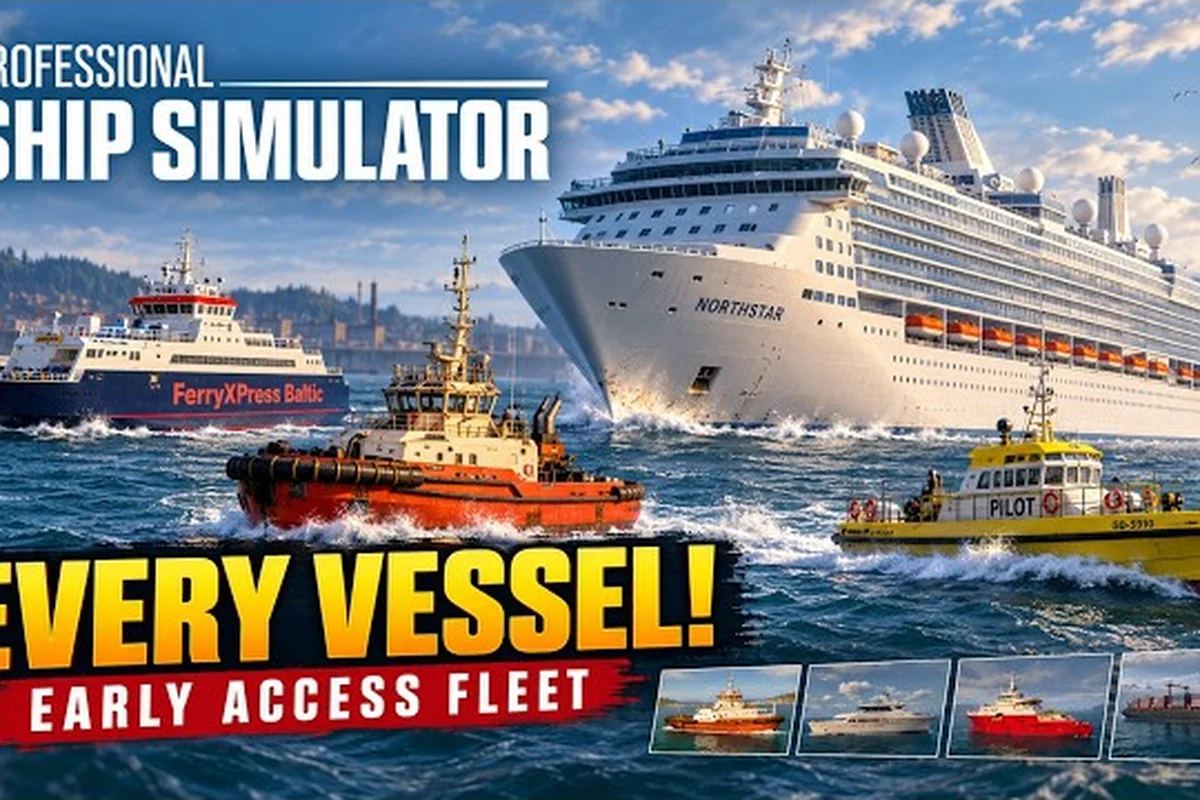
Choosing your first hull in Professional Ship Simulator sets the tone for every mission you'll ever run, because the class you start with determines which licenses unlock next, which harbors pay the best contracts, and which specializations you can stack later. This full Professional Ship Simulator ship list walks through every confirmed class in Early Access, from the nimble pilot boat that threads between freighters in Ralswiek to the LNG tanker that earns six-figure payouts on the Baltic Sea. You'll see the specs that matter, the mission types each hull unlocks, and the realistic choice for a first purchase so you can stop guessing and start hauling.
Every Ship Class in the Professional Ship Simulator Ship List
The full Professional Ship Simulator ship list is organized by mission role, not by tonnage, which is why a 14-meter pilot boat sits in the same progression tier as a 200-meter container ship. Each class is a license category that gates which contracts appear on the harbor mission board, and the dry dock only sells hulls you've already unlocked through license checks. Understanding that license-first economy is the key to planning an efficient career.
Confirmed Classes in Early Access
According to the Available Ship Classes knowledge base, the Early Access roster breaks down into eight role-based classes. Below is a summary table of every class, its primary mission role, and the earliest harbor where it shows up on the dry dock.
| Class | Primary Role | Typical Length | First Available Harbor | Notes |
|---|---|---|---|---|
| Pilot Boat | Transfer maritime pilots to moving vessels | ~14 m | Ralswiek | Only class that can run pilot/inspection tasks |
| Harbor Tug | Assist large vessels in/out of port | ~30 m | Ralswiek | Required for escort contracts |
| Fishing Vessel | All fishing mission types | 18–35 m | Ralswiek | Net, longline, and trawl variants |
| Ferry | Passenger transfer between harbors | 40–80 m | Coastal hubs | Scheduled routes only |
| Cargo Ship | General freight hauling | 90–180 m | Major hubs | Container, bulk, and general cargo |
| Tanker | Liquid bulk transport | 120–300 m | Industrial ports | Oil, chemical, and product carriers |
| LNG Carrier | Liquefied natural gas transport | 200–300 m | Specialized terminals | Highest single-contract payout |
| Cruise Ship | Passenger cruises on long routes | 200–350 m | Tourist harbors | Slowest hull, biggest crew cost |
The eight-class structure means progression feels like a ladder, because each license check tends to require either credits, mission count, or a reputation threshold in the previous class. For example, the LNG carrier license gates behind tanker missions, and the cruise ship license gates behind a combination of ferry runs and a harbor reputation rank. Players who skip ahead by buying hulls with real-world currency bypass the license ladder, but community testing suggests the license path produces more credits in the long run because higher-tier contracts pay exponentially more.
How Ship Classes Differ From Real-World Tonnage
Most simulators treat ships as a single tonnage slider, but Professional Ship Simulator ship classes are mission categories first and physics objects second. A pilot boat isn't just "small" — it's the only class that can take a pilot-boarding contract, and that exclusivity is what makes it a high-value starting pick. A harbor tug isn't just "medium" — it can attach to vessels three times its length and earn bonus credits for flawless docking assist, which means tug missions pay disproportionately well for the size of the hull.
The same logic applies at the top of the roster. An LNG carrier isn't just "big" — it requires specialized terminal infrastructure that only exists in a handful of harbors, and the contracts that spawn there reward six-figure payouts because the simulator simulates real-world supply chain scarcity. Cruise ships are the outlier in that they're large but slow, so they pay well on long routes but bleed credits on fuel if you take a short contract.
If you're trying to decide where to specialize, it helps to think of the eight classes as three tiers rather than eight ladders. The starter tier covers pilot boat, harbor tug, and fishing vessel; the mid tier covers ferry, cargo ship, and product tanker; the top tier covers LNG carrier and cruise ship. Most players report that committing to one mid-tier specialization and one top-tier goal produces the most stable credit curve.
Pilot Boat and Harbor Tug: The Best Beginner Ship Tier
For new players, the pilot boat and harbor tug together form what community guides call the best beginner ship pairing, because both classes earn credits fast, both are forgiving to handle, and both teach the core handling skills you'll need for every later hull. The Professional Ship Simulator best starting ship debate almost always comes down to one of these two.
Why the Pilot Boat Is the Top Recommended Starter
The pilot boat earns its reputation as the Professional Ship Simulator best starting ship for three concrete reasons: short contracts, high turnover, and a built-in skill curve. A typical pilot transfer takes 8–12 minutes from request to drop-off, which means a focused session can clear four to six contracts. Each contract pays in the mid-thousands of credits, so an hour of focused piloting outearns an hour of slow fishing on the same harbor.
The skill curve matters because every later class assumes you can dock a moving vessel next to another moving vessel. The pilot boat is the only class where this skill is the entire job, so by the time you've done fifty pilot transfers, you can handle most mid-tier contracts without a tutorial. A useful side benefit is that pilot boats are cheap to repair, which keeps the early-game credit bleed under control while you're still learning how to read currents in the Ralswiek channel.
Why the Harbor Tug Is the Strongest Alternative
The harbor tug takes longer per contract but pays more per run, which makes it the Professional Ship Simulator best ship for players who prefer fewer contracts with higher stakes. A standard assist-and-escort contract for a container ship pays roughly double a pilot transfer, but the time commitment is 20–30 minutes because you have to push, pull, and brake a much larger vessel through a narrow channel. The payoff is that tug missions are where most players first encounter the simulator's advanced physics, including line tension, drift, and tug-vector steering.
A practical piece of advice from long-time players is to alternate pilot and tug contracts during the first ten hours, because the muscle memory from each class reinforces the other. Pilot transfers teach you to read a moving target, while tug assists teach you to control momentum in a larger body. The two skills compound, and by the time you unlock the ferry or cargo ship licenses, you'll be comfortable handling vessels several times larger than your starter hull.
Pilot Boat vs. Harbor Tug: Side-by-Side Comparison
| Attribute | Pilot Boat | Harbor Tug |
|---|---|---|
| Average contract length | 8–12 min | 20–30 min |
| Average payout (Early Access) | 2,000–4,000 cr | 5,000–9,000 cr |
| Required skill focus | Lateral precision, timing | Power application, line work |
| Repair cost per session | Low | Medium |
| License prerequisite | None (starter) | 5 successful pilot missions |
| Best for | Quick credit farming | Higher-payout-per-hour goals |
The numbers above come from a mix of the Career knowledge base page and community-reported averages, and they shift slightly with each Early Access patch. The takeaway is that there's no wrong pick — both classes rank as the best beginner ship option because both are profitable, both are forgiving, and both prepare you for the larger classes ahead.
Mid-Tier Classes: Ferry, Cargo, and Tanker
The mid-tier of the Professional Ship Simulator all ships roster is where most players spend the bulk of their career hours, because the contracts are stable, the harbors are more numerous, and the license gates are forgiving. The Professional Ship Simulator ship classes in this tier each have a distinct personality, and the right pick depends on whether you prefer predictable schedules, heavy haul work, or industrial route variety.
Ferry: The Scheduled-Route Specialist
The ferry is the closest thing the simulator has to a public transit job, because you pick up passengers at one harbor, follow a fixed channel, and drop them at a destination harbor on a repeating schedule. The pay isn't the highest in the mid-tier, but the contracts are predictable and the routes are short enough that you can stack multiple runs per session. Ferries are also the first class where weather starts to matter in a meaningful way, because passenger comfort ratings drop when you push through heavy swells, and comfort ratings feed back into your final payout.
Cargo Ship: The Backbone of the Mid-Tier
Cargo ships are the workhorse class and the most common pick for the Professional Ship Simulator best ship title in the mid-tier. A single container run from a Baltic hub to a North Sea port pays more than a full day of ferry work, and the contracts are flexible enough that you can take short coastal hauls or longer international runs depending on your available time. The class also includes bulk carriers and general cargo variants, which means the actual ship handling differs noticeably between sub-types. Container ships accelerate and turn faster, while bulk carriers are heavier and more momentum-bound.
Tanker: The Industrial Middle Ground
Tankers sit between cargo and LNG in both size and complexity, and they're where most players first encounter the simulator's liquid-cargo systems. Oil, chemical, and product carriers each have slightly different loading and discharge procedures, and the contracts tend to cluster around industrial harbors where the pay is good but the traffic is heavy. According to community data shared in the Professional Ship Simulator Steam community, tankers are the most common specialization for players who prefer fewer, higher-stakes contracts.
Mid-Tier Class Comparison
| Class | Best Use | Contract Length | Payout Range | Key Skill |
|---|---|---|---|---|
| Ferry | Scheduled passenger routes | 15–25 min | 4,000–7,000 cr | Schedule discipline, weather reading |
| Cargo Ship | General freight hauling | 30–60 min | 12,000–25,000 cr | Channel navigation, port entry |
| Tanker | Liquid bulk transport | 40–75 min | 18,000–35,000 cr | Pump timing, harbor approach |
If you're looking for the Professional Ship Simulator best ship in the mid-tier, cargo is the consensus pick for credit-per-hour, but ferry wins on session flexibility, and tanker wins on prestige and contract variety. The right answer depends on how you like to play, and the simulator's license system lets you hold multiple mid-tier licenses at once, so there's no real cost to experimenting across all three before committing to a top-tier specialization.
Top-Tier Classes: LNG Carrier and Cruise Ship
The top tier of the Professional Ship Simulator ship list is where credits stop being a concern and the simulator shifts toward logistical planning and prestige. Both the LNG carrier and the cruise ship are gated behind license chains that require mid-tier mastery, and both demand a significant time and credit investment to operate profitably. The Professional Ship Simulator best ship at this level is more about playstyle than pure payout, because both classes earn well but require very different approaches.
LNG Carrier: The High-Payout Specialist
The LNG carrier is the highest-paying hull in Early Access, and it earns that reputation through contract scarcity and infrastructure requirements. Liquefied natural gas transport contracts only spawn at specialized terminals, and the simulator's economy is tuned so that the supply chain rarely has more than one or two open contracts at a time. That scarcity means each contract pays six figures, but it also means downtime between contracts is longer than in any other class. The hull itself is long, slow, and momentum-heavy, which makes harbor approaches unforgiving if you cut corners, and the simulator punishes miscalculated turns with collision penalties that can wipe out an entire contract's profit.
A practical approach recommended by experienced players is to pair LNG contracts with a backup mid-tier hull so that downtime between top-tier runs still produces credits. The simulator lets you switch between owned vessels freely through the dry dock menu, which means you can take an LNG run, dock, and immediately queue a cargo contract while waiting for the next LNG spawn.
Cruise Ship: The Prestige Long-Route Vessel
The cruise ship is the largest hull in the Professional Ship Simulator all ships roster, and it's the only class where route planning matters more than handling. A typical cruise contract runs several hours of simulated time, during which you maintain a steady cruising speed, manage passenger comfort through weather and course decisions, and arrive at a tourist harbor on schedule. The pay is comparable to LNG, but the workload is more about patience than precision. Players who enjoy long, immersive sessions tend to gravitate toward cruise, while players who prefer high-stakes, shorter runs tend to stay with LNG.
Top-Tier Class Comparison
| Attribute | LNG Carrier | Cruise Ship |
|---|---|---|
| Average contract payout | 80,000–150,000 cr | 60,000–120,000 cr |
| Contract length (sim time) | 2–4 hours | 3–5 hours |
| Harbor availability | Specialized LNG terminals | Tourist harbors only |
| Handling difficulty | Very high (long, momentum-heavy) | Medium (stable, slow) |
| Best for | High-payout specialists | Long-session route planners |
The Professional Ship Simulator best ship title at the top tier is genuinely a preference call, because both classes outearn every mid-tier hull by a wide margin. The choice comes down to whether you want shorter, higher-stakes LNG runs or longer, lower-pressure cruise routes. Most players report that the LNG carrier feels more rewarding per session, while the cruise ship feels more rewarding per contract.
Picking Your First Ship and Building a Fleet
For players still at the dry dock deciding what to buy first, the Professional Ship Simulator best starting ship is almost always the pilot boat, with the harbor tug as the strongest second pick. Once you've earned enough credits to afford a second hull, the most efficient fleet pattern is one starter hull for quick contracts, one mid-tier hull for steady income, and one top-tier hull for the big payouts.
A Practical First-Hour Purchase Path
The fastest first-hour progression looks like this: buy the pilot boat, run pilot/inspection contracts until you have the tug license, buy the harbor tug, alternate between pilot and tug contracts until the ferry license, then decide whether you want to commit to ferry routes or push into cargo. According to the Career knowledge base, the dry dock only sells hulls you've unlocked, so the purchase order above also doubles as the license order, which means the simulator guides your progression almost as much as your credit balance.
A useful tip from the community is to always keep at least one starter-class hull in your fleet even after you've moved up the ladder, because pilot and tug contracts fill the gaps between long mid-tier and top-tier runs. The simulator doesn't penalize you for owning multiple hulls, and the dry dock storage is free, so there's no real cost to maintaining a small fleet.
Fleet Composition for Steady Credit Flow
| Fleet Slot | Recommended Class | Role |
|---|---|---|
| Slot 1 | Pilot boat or harbor tug | Quick contracts, gap filler |
| Slot 2 | Cargo ship or ferry | Steady mid-tier income |
| Slot 3 | LNG carrier or cruise ship | High-payout specialty runs |
If you want to expand your fleet further, the Professional Ship Simulator ship mods and community-recommended workshop add-ons can introduce additional variants of the existing classes, which is a cost-effective way to specialize without grinding a new license. The broader mod ecosystem also opens up custom hulls that fill gaps the base roster doesn't cover, and you can browse the most popular options through our guide on the Professional Ship Simulator Steam Workshop mods if you want to expand beyond the official ship list.
Frequently Asked Questions
What is the best starting ship in Professional Ship Simulator?
The pilot boat is the Professional Ship Simulator best starting ship because contracts are short, payouts are competitive for the early game, and the handling skills transfer directly to every later class. The harbor tug is the strongest second pick, especially if you prefer fewer, higher-payout contracts.
How many ship classes are in Early Access?
Early Access ships list currently includes eight confirmed ship classes: pilot boat, harbor tug, fishing vessel, ferry, cargo ship, tanker, LNG carrier, and cruise ship. Each ship class is a separate license category that gates the contracts you can accept and the dry dock hull purchases you can unlock, so the Professional Ship Simulator ship list directly defines both your earning potential and your progression route during Early Access.
Which ship class pays the most per contract?
The LNG carrier tops the Professional Ship Simulator ship list for single-contract payouts, with typical runs paying between 80,000 and 150,000 credits depending on route length and port fees. The cruise ship follows closely, with contracts paying 60,000 to 120,000 credits on longer routes, though it requires the largest dry dock hull purchase in Early Access.
Can I own multiple ships at the same time?
Yes. The dry dock stores unlimited owned hulls for free, and you can switch between them from the laptop menu inside your residence, making it easy to swap from a compact pilot boat to a high-payout LNG carrier between contract types. Most experienced players maintain at least two or three hulls to cover different contract types, such as pairing a fast harbor tug for short harbor jobs with a tanker for longer regional routes.
Do I need to play every ship class to progress?
No. The license system is mostly linear, but you can skip the fishing vessel class without losing access to higher tiers. The Professional Ship Simulator best ship for progression speed is pilot boat → harbor tug → cargo ship → LNG carrier, because each step in that chain builds on the previous class's skills.