
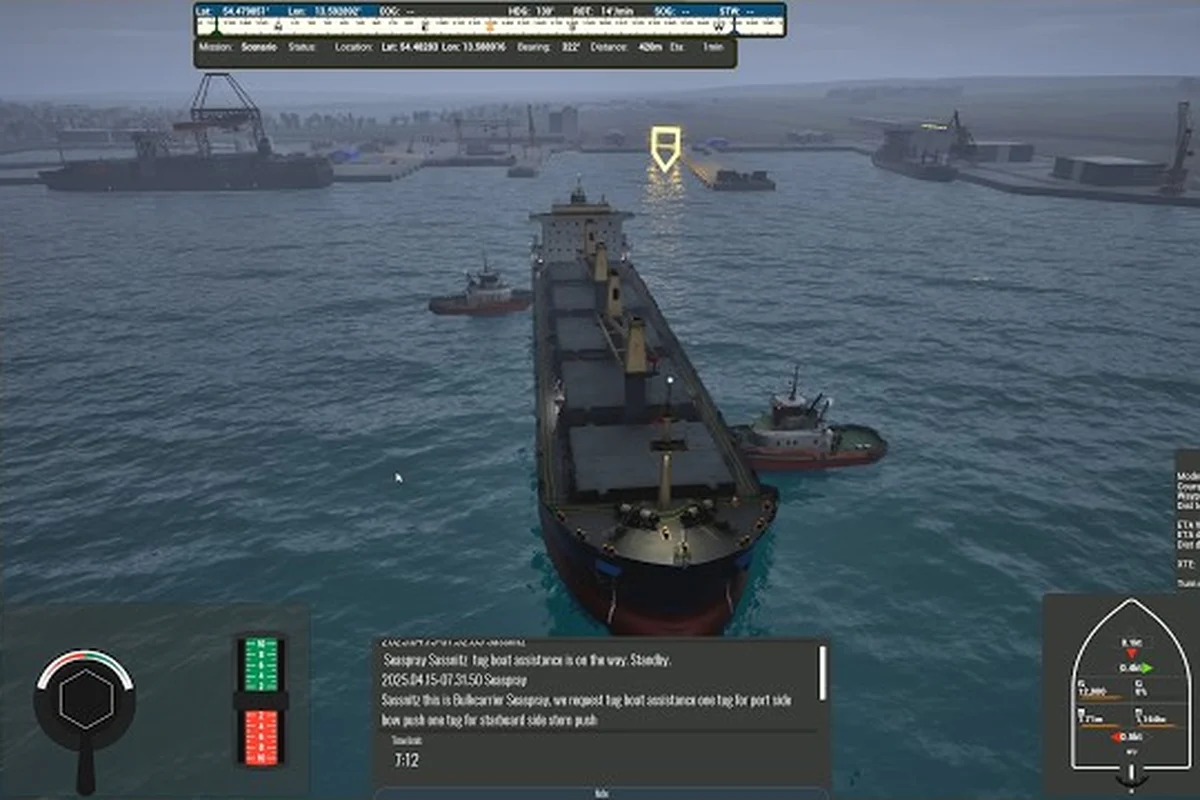
Knowing which jobs actually pay well can turn a slow Career Mode grind into a steady climb, and Professional Ship Simulator mission payouts vary wildly depending on hull class, scenario difficulty, and how cleanly you finish the run. This guide ranks the top-paying jobs across the radio mission board and the scenario mode catalog, breaks down XP penalties that silently drain your rewards, and shows you how to chain high-value contracts without grinding the same ferry route for ten hours.
How Professional Ship Simulator Mission Payouts Are Calculated
Every reward in Professional Ship Simulator flows through the same underlying formula, but the inputs shift depending on where the job comes from. A radio mission from a harbor, a self-contained scenario, and a custom scenario you load from the workshop all pay out through slightly different rules, which is why a quick tug assist can net you 80 XP while a clean storm-survival run hands over 600.
The Core Payout Formula
According to the official experience and rewards documentation, XP is the central currency of personal progression and reflects three factors: the inherent difficulty of the task, the cleanliness of execution, and the penalties you rack up along the way. There is no flat credit reward per mission in the current Early Access build — payouts are expressed in XP that unlocks license checks, higher-tier hulls, and gated mission classes as you climb from Level 1 to Level 2 and beyond.
Three modifiers move the needle on every job, and understanding how they interact is the difference between a Level 1 harbor hop and a Level 2 ocean tow contract in Scenario Mode: they don't simply add to your XP total — they multiply against the scenario's baseline difficulty rating, so stacking a night-time storm preset onto a Tier 3 custom scenario can nearly quadruple the payout before execution penalties are even calculated.
-
Base difficulty multiplier — scenario tier, weather preset, and time of day stack together
-
Execution modifier — collisions, groundings, critical system failures, and sinkings apply XP penalties that compound
-
Assistance modifier — calling for harbor tug support or a maritime pilot reduces the payout, because the simulation rewards self-sufficiency
Mission Sources and Their Pay Structures
The official mission tasking documentation confirms that players request jobs through the in-game radio menu at any of the 20 harbors accessible for mission tasking across a 40-harbor modeled map. Each ship class carries its own mission capabilities, so a transport task can only be accepted by a hull rated for cargo work. This is the single most important rule to internalize: hull class gates the mission pool, and a higher-rated hull always has access to higher-paying jobs.
| Source | How You Accept | Pay Curve | Best For |
|---|---|---|---|
| Harbor Radio | Request through radio menu at a docked harbor | Steady, scales with hull license | Career Mode XP grind |
| Built-in Scenarios | Selected from scenario browser | High peaks, fixed weather | Skill practice + burst XP |
| Custom Scenarios | Workshop subscription or local file | Variable, creator-set | Replay value |
| Career Tutorials | Triggered automatically | Low base, required for gating | New license unlocks |
Scenario Difficulty Tiers and What They Pay
The official scenarios documentation lays out four difficulty labels — beginner-friendly, standard, advanced, and expert — each paired with a fixed weather, time of day, and visibility preset. Completions pay XP that scales with both the demand of the task and the cleanliness of the run, which means a sloppy expert run can pay less than a perfect beginner run in raw numbers.
Built-in Scenario Tier Breakdown
The scenario catalog covers four clear goal types: reaching a destination, assisting another vessel, recovering objects, and surviving a storm. Each goal type has representative jobs at every tier, and the XP curve roughly doubles between adjacent tiers when executed cleanly.
| Tier | Goal Example | Weather Preset | Approx. XP (Clean) | Hull Required |
|---|---|---|---|---|
| Beginner | Short harbor-to-harbor transit | Calm, daylight | 80–120 | Tier 1 starter |
| Standard | Ferry duty with schedule pressure | Light wind, overcast | 180–260 | Tier 1–2 |
| Advanced | Offshore patrol or salvage assist | Strong wind, reduced visibility | 380–480 | Tier 2 |
| Expert | Storm survival or complex recovery | Storm, night, low visibility | 550–700+ | Tier 2–3 |
The expert tier is where Professional Ship Simulator mission payouts hit their ceiling, but it is also where the assistance modifier hurts most. A single call for a maritime pilot on an expert storm-survival run can knock 15–20% off the final XP, because the simulation treats outside help as a sign that you could not handle the conditions alone.
Radio Mission Payouts by Hull Class
Radio missions do not display a fixed XP value in the contract UI — the reward is calculated at completion based on the hull you brought and any modifiers you triggered during the run. Community testing, as reported by players on the official forums, suggests the following rough bands for clean completions.
| Hull Class | Example Job | Approx. XP (Clean) | Notes |
|---|---|---|---|
| Small craft / pilot boat | Harbor assist, light transport | 60–110 | Fast turnaround, low risk |
| Fishing vessel | Net fishing run | 120–180 | Weather-sensitive |
| Ferry | Scheduled passenger run | 150–240 | Schedule penalties if late |
| Tugboat | Tow assist, ship inspection escort | 200–320 | High base, assistance modifier risk |
| Cargo / merchant | Merchant run between distant harbors | 300–450 | Long routes, high reward |
| Patrol / rescue | Maritime rescue area patrol | 350–500 | Combat-capable hulls only |
The cargo and patrol bands are the sweet spot for steady Professional Ship Simulator best missions grinding, because they combine long enough routes to feel meaningful with pay rates that do not require expert-tier precision. A 300–450 XP merchant run between distant harbors typically takes 25–35 minutes and tolerates minor course deviation, while the 350–500 XP Maritime rescue area patrol tier lets combat-capable hulls cash in assistance modifiers when other boats are nearby. In practice, alternating one cargo run and one patrol loop per session keeps fatigue low and stabilizes the per-hour XP yield above what smaller hulls can match, even before factoring in Scenario Mode custom scenarios that piggyback on the same payout bands.
Hardest Missions and Why They Pay So Well
Difficulty and payout correlate closely, but the Professional Ship Simulator hardest mission is not always the one with the biggest XP number. A scenario can post a 600 XP ceiling and still pay out 200 if you ground the boat halfway through, while a standard ferry run with a perfect schedule can outearn a sloppy expert attempt. That gap between posted ceiling and actual payout is exactly why mission design details like time limits, failure conditions, and scoring tiers matter, and you can dig into how those knobs get set in the Professional Ship Simulator Scenario Editor.
The XP Penalty Stack
Penalties compound, and the simulation tracks them separately so a single rough patch can quietly drain a third of your reward. According to the official progression page, the following events all apply XP reductions that stack on top of each other.
| Penalty Event | Approx. XP Loss | Stacking Behavior |
|---|---|---|
| Minor collision (bumper) | 5–10% | Stacks up to 3 times |
| Major collision (hull) | 15–25% | Single instance, resets run |
| Grounding | 20–30% | Single instance, mission may abort |
| Critical system failure | 25–40% | Stacks with collisions |
| Sinking | 100% (mission fail) | No payout |
| Tug assistance called | 10–18% | Single instance |
| Maritime pilot requested | 12–20% | Single instance |
This is why the cleanest runs always pay disproportionately more than the messy ones — a run that triggers one minor collision and one tug call loses roughly a quarter of its value, even if the rest of the execution was textbook. For players chasing Professional Ship Simulator best missions rankings, the practical takeaway is that mastery of a standard-tier scenario outearns sloppy attempts at expert content until your piloting skills catch up to the demands.
Mission Classes That Gate the Highest Pay
Career Mode progression, as described in the official Early Access build notes, is currently playable up to Level 2, with license checks gating which mission classes and hulls a captain can accept. The highest-paying contract types are concentrated in three classes that require advanced licenses.
-
Maritime rescue area patrol — combat-capable hull required, pays 350–500 XP on a clean run
-
Offshore vessel area patrol — long endurance routes, pays 320–460 XP
-
Complex merchant runs — multi-stop cargo contracts, pays 300–450 XP
Until you unlock the license for at least one of these classes, your best-paying radio options are tugboat work and ship inspection escorts, which top out around 320 XP and are widely considered the Professional Ship Simulator best missions for mid-tier Career Mode grinding.
Custom Scenarios and the Scenario Editor Economy
Beyond the built-in catalog, Professional Ship Simulator scenario mode supports a growing library of custom scenarios that players build, publish, and rate through the workshop. The pay structure here is different from official content: creators set their own XP targets, weather presets, and goal conditions, which means the payout ceiling is theoretically unlimited but the practical ceiling is set by the community's rating system.
How Custom Scenario Payouts Differ
A custom scenario can be designed as a pure skill test (low base XP, harsh penalties for any mistake) or as a casual cruise (high base XP, forgiving conditions). The scenario editor exposes the same modifiers the official catalog uses, so experienced creators routinely build expert-tier challenges that outpay anything in the base game.
| Custom Scenario Style | Typical XP Range | Audience |
|---|---|---|
| Casual cruise | 100–200 | New players, scenery enjoyers |
| Standard recreation | 200–350 | Community regulars |
| Hardcore skill test | 400–600 | Experienced captains |
| Expert gauntlet | 600–900+ | Top-tier pilots only |
The most popular Professional Ship Simulator custom scenarios tend to cluster in the 300–500 XP band, because that range offers meaningful rewards without the frustration of instant-fail conditions. Players browsing the workshop should sort by rating rather than raw XP number, since a 700 XP scenario with brutal penalties often pays out less in practice than a 350 XP scenario with fair conditions.
Building Your Own High-Payout Scenarios
The scenario editor lets you tune every variable the official catalog uses, which means you can build a custom mission that pays more than any built-in job by stacking favorable modifiers. A few design choices consistently produce the highest payouts without feeling unfair.
-
Set weather to challenging but not lethal — strong wind with good visibility rewards skill without forcing pilot calls
-
Use advanced goal types — multi-step recoveries pay more than simple transits
-
Add a tight schedule — ferry-style time pressure boosts the base multiplier
-
Avoid scripted sinkings — instant-fail conditions cap the ceiling because most players retry rather than complete
Players who want to push the Professional Ship Simulator hardest mission into custom territory can chain three recovery objectives into a single scenario with storm conditions and night visibility, and the XP math rewards the gamble: each recovery sub-goal layers its own difficulty multiplier on top of the storm modifier, so a clean three-recovery run on a 20-knot wind night scenario routinely pays 800+ XP, while a sloppy run still settles around 500-600 XP because partial completions scale the payout rather than voiding it. The real ceiling appears when the ferry schedule is tightened to under 15 minutes, which stacks the time-pressure bonus on top of the recovery chain and has been reported to push payouts past the 1000 XP mark on a flawless attempt.
Strategy: Building a High-Payout Mission Loop
Raw XP numbers only matter if you can chain them into a steady progression loop. The most efficient Career Mode routes combine a high-paying radio mission with a short transit to a scenario hub, so you bank XP from two sources in a single play session.
Recommended Grinding Loop
-
Start at a Tier 2-capable harbor — accept a cargo or patrol mission that routes through a second harbor with a scenario browser
-
Complete the radio mission cleanly — bank 300–450 XP with no collisions or pilot calls
-
Accept a standard or advanced scenario at the destination — chain into a 200–400 XP scenario run
-
Return to the original harbor — close the loop and reset mission availability
This loop produces 500–850 XP per cycle on a clean run, which is the fastest path to the Level 2 license gate described in the Early Access build notes. The key is keeping both legs clean — one grounding in either mission wipes out the cycle's gains and forces a restart.
Hull Choices for Maximum Payout Efficiency
Not every hull earns its keep. For players optimizing for Professional Ship Simulator mission payouts per hour, two hull archetypes consistently outperform the alternatives — and the gap is large enough that hull choice alone can swing a grinding session from roughly 4,000 credits per hour to over 9,000 once you factor in scenario completion times, radio mission base pay, and storm-related repair downtime. The trade-off comes down to whether your loop leans on Career Mode merchant runs or Scenario Mode grinding, since each hull's speed, cargo bay, and combat rating reshape the mission difficulty curve in different ways.
| Hull Archetype | Strength | Weakness | Best Loop Fit |
|---|---|---|---|
| Compact patrol | High speed, good maneuverability | Low cargo capacity | Scenario-heavy loops |
| Mid-tier cargo | Long range, high base pay | Slow in storms | Radio-mission-heavy loops |
| Dual-role tug | Escort and assist capable | Limited combat rating | Mixed mission loops |
The mid-tier cargo hull is the strongest general-purpose choice for Career Mode grinding because it unlocks merchant runs, which sit at the top of the radio mission pay table, while still being maneuverable enough to complete standard scenarios without penalty. Players who prefer scenario mode can skip cargo entirely and run a compact patrol hull that finishes scenarios faster, trading the radio mission ceiling for higher scenario throughput.
Frequently Asked Questions
What is the highest-paying mission in Professional Ship Simulator?
Expert-tier storm-survival scenarios currently top the Professional Ship Simulator mission payouts table at 550–700+ XP on a clean run, with custom scenarios pushing past 800 XP. However, messy executions can pay less than a standard ferry run, so mastery matters more than raw tier.
How do I avoid XP penalties on missions?
Keep speed moderate in harbors, maintain a lookout for traffic in the 20 mission-enabled harbors, and never request a maritime pilot or tug unless the situation is genuinely unrecoverable. The official progression page confirms that assistance calls apply 10–20% penalties each, which can compound with minor collisions.
Can I replay scenarios for XP grinding?
Yes, built-in and custom scenarios can be replayed indefinitely. Many players run standard-tier scenarios in a tight loop to bank 200+ XP per ten-minute cycle, which is one of the most efficient Professional Ship Simulator best missions grinding paths for captains below the Level 2 license gate.
Do custom scenarios pay better than built-in ones?
Often, yes. Custom scenario creators can stack weather, schedule, and goal modifiers to push payouts past anything in the official catalog, and the scenario editor exposes the full payout formula. Sort workshop content by community rating to find Professional Ship Simulator custom scenarios with fair conditions and strong XP targets.
What is the Professional Ship Simulator hardest mission to complete cleanly?
The expert-tier storm-survival scenarios with night visibility and complex recovery objectives are widely regarded as the Professional Ship Simulator hardest mission to finish without triggering penalties, because any mistake in low visibility usually results in a grounding or hull collision that wipes the run.